

The 5 Factors That Determine Baseball Card Value
Baseball card pricing isn't random. Five core factors drive nearly every card's market value — from a $0.25 common to a multi-million-dollar T206 Wagner. Understanding all five is essential before you can accurately price any card in your collection.
Player
Hall of Famers and active stars command massive premiums. A common player's card from the same set may be worth pennies.
Year & Set
Vintage cards from T206, 1952 Topps, and early Bowman carry scarcity premiums. Key sets are worth far more than contemporary issues.
Card Number
Rookie cards, short prints, and low card numbers consistently carry the highest collector demand within any given set.
Condition
Centering, corner wear, edge quality, and surface condition. A PSA 10 can be worth 5–10x the same card in raw condition.
Rarity
Short print variations, parallels, autographs, and 1/1 printing plates — the lower the print run, the higher the value ceiling.
The Most Important Lesson: A great player on a damaged card is still nearly worthless. All five factors must align to produce a truly valuable card — especially condition, which is the single biggest lever you can control.
Player: Hall of Famer vs. Common
The player depicted is the foundation of value. A Mickey Mantle rookie card from 1951 can be worth hundreds of thousands of dollars. A card of the third-string catcher from the same set? Maybe a dollar. Hall of Famers, active superstars (Shohei Ohtani, Juan Soto), and historically significant players (Babe Ruth, Willie Mays, Ted Williams) generate the most collector demand. Rookies of players who later became stars are often the most valuable cards in any set.
Year and Set: Vintage Premium and Key Sets
Pre-war cards (pre-1945) are scarce by nature — most were produced in small quantities for tobacco companies or candy stores and have had a century to disappear. Post-war Topps and Bowman sets from the 1950s feature the first mainstream rookie cards of legends. The 1952 Topps set in particular is considered the holy grail of post-war card collecting. In contrast, cards from the overproduction era (1987–1994) are so common that most have little collectible value today.
Card Number: Rookies and Low Numbers
Within any set, a player's rookie card — the first mainstream card issued during their debut season — is almost always the most valuable. Short prints (SPs) are cards intentionally produced at a lower quantity than the base set and carry a significant premium. Numbered parallels (/10, /25, /50) are strictly limited and valued accordingly. The rarest of all: printing plates and 1/1 cards.
Condition: The Single Biggest Value Driver
Two identical cards of the same player, year, and set can have wildly different values based solely on condition. Professional graders evaluate four attributes: centering (border ratios on all four sides), corners (any fraying or wear under magnification), edges (nicks or chips on the card edges), and surface (scratches, print defects, staining). A professionally graded PSA 10 Gem Mint can command 5–15x the price of an ungraded (raw) copy of the same card.
Rarity: Print Run, Parallels, Autos, and 1/1s
Modern card sets are engineered for rarity across multiple tiers. Base parallels may be printed to 999 or 500 copies, while refractors might be /99, gold /50, and superfractors 1/1. Autographed cards carry additional premium because they represent a direct connection to the player. Patch autos — featuring an embedded swatch of game-used jersey along with an autograph — are among the most desirable modern inserts in any sport.
How to Check Baseball Card Prices: 4 Methods
There are four reliable methods to find out what your baseball cards are worth. Used together, they give you the most complete picture of current market value.
eBay Sold Listings
Filter to "Sold Items" under eBay search results. This shows real transaction prices — not asking prices — which is the most accurate reflection of current market value for raw cards.
PSA Price Guide & Pop Report
The PSA Price Guide provides graded card values, while the Population Report shows how many cards have been graded at each level — critical context for scarcity of high grades.
CardValueFinder AI Scanner
Upload or scan your card at CardValueFinder.com for an instant free estimate powered by real market data. No account required for basic pricing.
Beckett Price Guide
Beckett's database covers hundreds of thousands of cards with high and low values. Most useful for older cards where eBay sold data is sparse. Available in print and online.
Always use eBay Sold Listings as your primary reference. Asking prices on eBay, COMC, or dealer sites can be 2–5x actual market value. Sold listings reflect what buyers are actually willing to pay right now — the only number that matters when you're ready to sell.
Baseball Card Condition Guide
Professional Sports Authenticator (PSA) uses a 1–10 grading scale. The grade your card receives is the single largest determinant of its value after the player and year. Here's exactly what each grade means and its typical impact on value relative to an ungraded raw card:
| PSA Grade | Condition Label | What It Means | Value Impact vs. Raw |
|---|---|---|---|
| 10 | Gem Mint | Perfect centering (60/40 or better), four razor-sharp corners, no edge issues, flawless surface on both sides. | 3–10x raw value |
| 9 | Mint | Near perfect. May have one minor allowable flaw — slight centering variation or barely perceptible corner touch. | 2–5x raw value |
| 8 | NM-MT | Near Mint–Mint. Slight centering, one or two very minor corner or edge imperfections. Strong overall eye appeal. | 1.5–3x raw value |
| 7 | NM | Near Mint. Light play wear visible on one or two corners. Surface may show very faint scratch under bright light. | 1–2x raw value |
| 6 | EX-MT | Excellent–Mint. Moderate corner rounding, minor surface wear visible to the naked eye but card still presents well. | 50–80% of raw |
| 5 or less | EX and below | Obvious wear, heavy corner fraying, creasing, staining, or surface damage clearly visible without magnification. | 20–50% of raw |
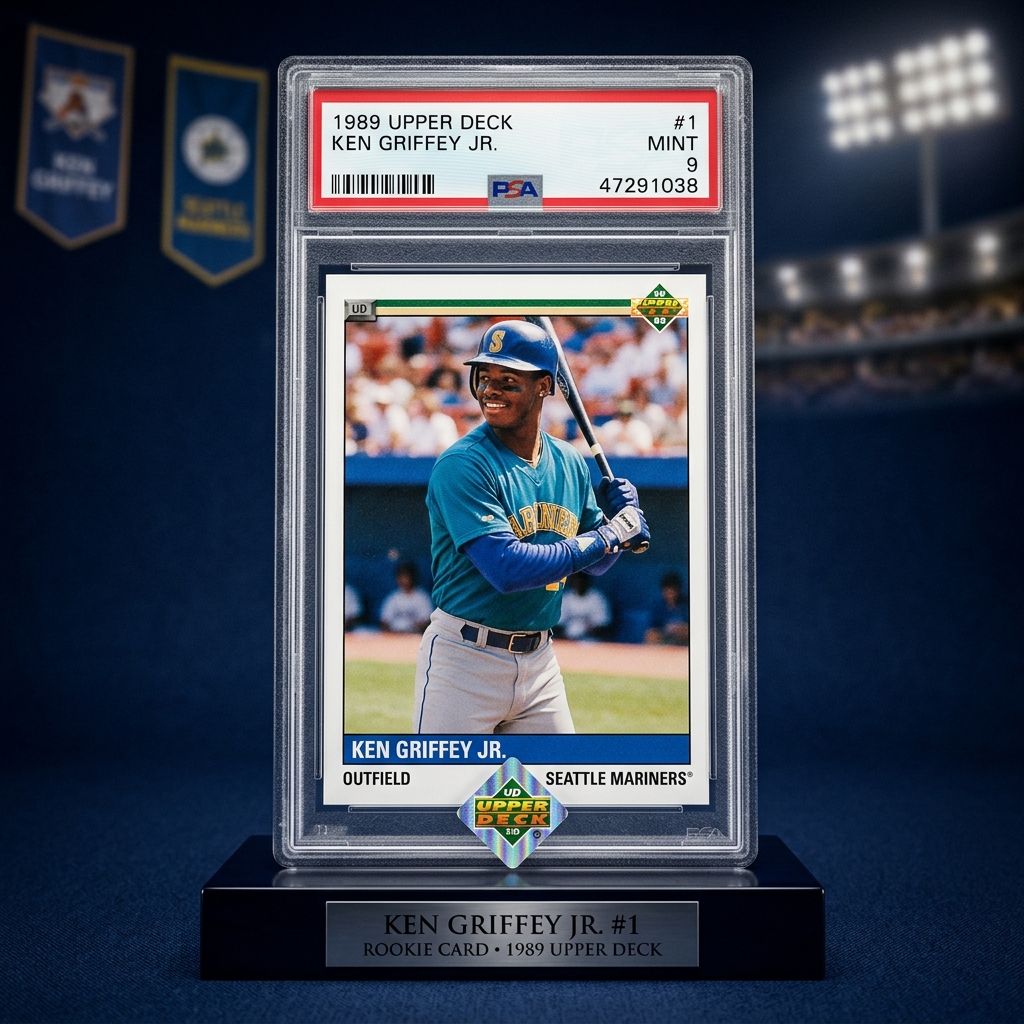
Key Insight: The difference between a PSA 9 and PSA 10 is often enormous for desirable cards. A 1989 Upper Deck Ken Griffey Jr. RC might sell for $300 in a PSA 9 and $2,000+ in a PSA 10. Understanding which grade your card is likely to receive is critical before spending money on submission. Use our How to Grade Sports Cards guide to pre-screen your card's condition.
Most Valuable Baseball Cards by Era
The baseball card market is organized by distinct collecting eras, each with its own scarcity dynamics, production history, and collector base. Knowing which era your cards come from sets realistic expectations about their value ceiling.
The oldest and rarest cards in the hobby. Produced for tobacco companies and candy stores in tiny quantities.
- T206 Honus Wagner — $1M–$7M+
- 1933 Goudey Babe Ruth — $50K–$500K
- T206 Ty Cobb — $10K–$100K
- 1914 Cracker Jack Ruth RC — $500K+
The golden age of Topps and Bowman. Features the first mainstream rookie cards of baseball's greatest legends.
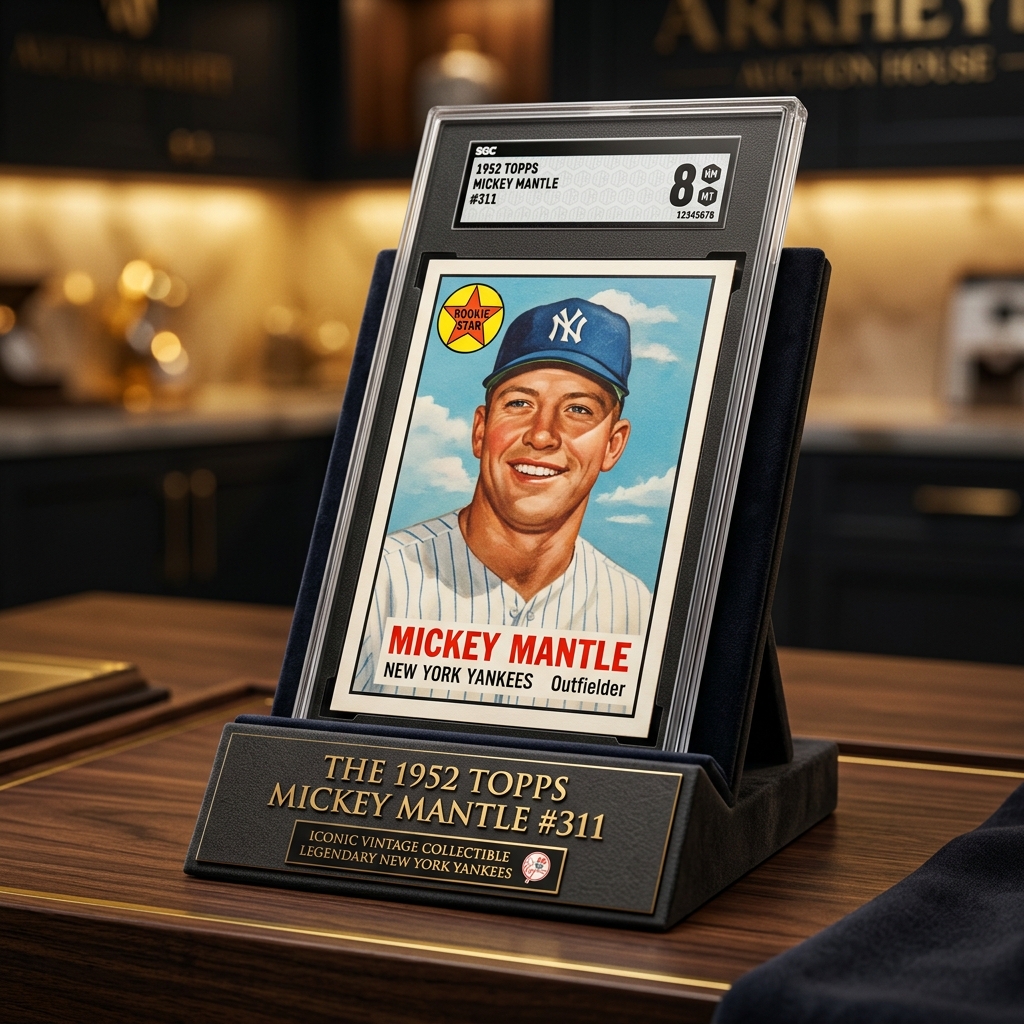
- 1952 Topps Mickey Mantle #311
- 1955 Topps Roberto Clemente RC
- 1951 Bowman Willie Mays RC
- 1968 Topps Nolan Ryan RC
Massively overproduced. Most cards are worth under $1. Only superstar rookies in top condition have real value.
- 1989 UD Ken Griffey Jr. RC
- 1990 Leaf Frank Thomas RC
- 1992 Bowman Mariano Rivera RC
- 1987 Topps Barry Bonds RC
Rookie card collecting dominates. Parallels, autos, and patch cards have created a tiered market with huge price spreads.
- 1993 SP Derek Jeter RC
- 2011 Topps Update Mike Trout RC
- 2018 Topps Chrome Ohtani RC
- 2019 Topps Chrome Tatis Jr. RC
For a deeper look at current market values across all eras, see our dedicated Most Valuable Baseball Cards guide.
Baseball Cards That Look Valuable But Aren't
One of the most common misconceptions in card collecting involves the so-called "junk wax era" — roughly 1987 through 1994. During this period, card companies dramatically overproduced cards to meet collector demand, printing millions upon millions of sets that flooded the market and eliminated scarcity entirely.
Reality Check: If you found a box of baseball cards from the late 1980s or early 1990s in your parents' attic, they are almost certainly worth very little — typically $0.25 to $2 per card, or less. The overproduction was so extreme that even 30+ years later, supply still vastly exceeds collector demand for common players from this era.
What Makes a Junk Wax Card Worth Something?
The exceptions to the junk wax rule are important to know:
- Player quality matters most. Rookie cards of Hall of Famers (Griffey Jr., Thomas, Rivera) still have collector value — especially in PSA 9 or 10 condition.
- Condition is everything. A common junk wax card in PSA 10 can still sell for $10–$30 simply because finding a perfectly preserved example from cards handled carelessly by millions of kids is genuinely rare.
- Error cards. Misprints, inverted photos, and other error variants from this era occasionally carry premiums — the 1989 Fleer Billy Ripken "obscene bat knob" card being the most famous example.
- Complete sets in top condition. A complete factory-sealed 1987 Topps set in perfect condition has more value than the individual cards, as collectors prize sealed boxes for their certainty of condition.
If you're trying to sell a collection from this era, be realistic about values. Your best option is to identify the star players, check eBay sold listings for their specific cards, and bundle the rest as a lot.
How to Use CardValueFinder to Value Your Baseball Cards
CardValueFinder's AI-powered scanner provides instant baseball card valuations by using AI-powered market intelligence. Here's the three-step process:
Scan or Upload Your Card
Go to CardValueFinder.com and either use your phone camera to scan the card directly or upload a photo. The AI automatically identifies the player, year, set, and card number — no manual entry required.
Review the Market Data
The tool pulls sold listing data to show you the current raw market value, recent sales trends, and — where available — graded value comparisons for PSA 8, 9, and 10 versions of your card. You see exactly what the market is paying, not estimated catalog prices.
Decide: Sell Raw, Get Graded, or Hold
With accurate market data in hand, you can make an informed decision. If your card's PSA 10 value is substantially higher than the raw price plus grading costs, submission makes sense. If not, selling raw and using those proceeds to buy better cards is often the smarter move. See our grading cost guide for a complete breakdown of submission fees.
Is It Worth Getting Baseball Cards Graded?
Grading can multiply a card's value dramatically — but it can also be a costly mistake if the math doesn't work out. Here's a break-even analysis for two very different cards to show when grading makes sense and when it doesn't.
Example 1: 1989 Upper Deck Griffey Jr. RC — Grading Makes Sense
Break-Even Analysis: 1989 UD Griffey Jr. RC (PSA 10 candidate)
Example 2: 1991 Topps Common — Grading Never Makes Sense
Break-Even Analysis: 1991 Topps Common Player
The Golden Rule: Only submit a card for grading if the realistic graded value (accounting for the most likely grade you'll receive, not just the best-case PSA 10) exceeds the raw card value plus all costs by a meaningful margin. For most junk wax era cards, this threshold is never met. For vintage star cards and modern rookie autos, grading almost always adds net value.
For a full breakdown of what grading costs at each service tier, visit our Sports Card Grading Cost guide. To understand how graders evaluate cards before you submit, read our How to Grade Sports Cards guide.
Frequently Asked Questions
The most common questions collectors ask about valuing baseball cards — answered clearly.
The most accurate method is searching eBay's completed listings and filtering to "Sold Items" — this shows real prices collectors are actually paying. For an instant estimate, use the CardValueFinder AI scanner, which pulls from real sold market data. Always check both raw (ungraded) and graded sold comps to understand the full range of possible values for your card.
The most valuable old baseball cards are the T206 Honus Wagner (worth millions in any grade), the 1952 Topps Mickey Mantle #311 (a PSA 9 sold for $12.6 million in 2022), the 1955 Topps Roberto Clemente rookie, and the 1968 Topps Nolan Ryan rookie. Pre-war tobacco cards from the T206 set (1909–1911) as a whole are the most consistently valuable vintage cards — even common players can be worth hundreds of dollars due to their age and scarcity.
Most baseball cards from the junk wax era (roughly 1987–1994) are worth very little — typically $0.25 to $2 each — because they were massively overproduced. However, star player rookie cards like Ken Griffey Jr. (1989 Upper Deck), Frank Thomas (1990 Leaf), and Mariano Rivera (1992 Bowman) are meaningful exceptions, especially in top grades. A PSA 10 of the 1989 UD Griffey Jr. can sell for $2,000+. Condition is everything — even common junk wax cards in certified PSA 10 have collector value because perfect preservation from that era is genuinely rare.
Four core factors drive baseball card value: Player (Hall of Famers and superstars command enormous premiums), Condition (a PSA 10 can be worth 5–10x a raw copy), Year and Set (vintage cards from key sets carry scarcity premiums), and Rarity (short prints, parallels, autographs, and serial-numbered cards are exponentially more valuable). All four factors interact — even a Hall of Famer's card is nearly worthless if it's severely damaged, and even a perfect card of a common player has limited collector value.
eBay sold listings are the most accurate real-time pricing source for baseball cards — but you must always filter to Sold Items, not asking prices. Sellers routinely price cards at 2–5x market value, and asking prices are meaningless for valuation purposes. Beckett's price guide is a useful reference but can lag actual market conditions. The PSA Price Guide and Pop Report are valuable for understanding how rare a high grade is. CardValueFinder pulls from real sold data to provide current estimates quickly.
Grading makes financial sense only when the expected graded value substantially exceeds the raw card value plus the cost of grading and shipping. As a general rule: submit a card for grading only if the raw card is worth at least $75–$100, you believe it has strong PSA 9 or PSA 10 potential, and the PSA 10 sold price is at least 3–5x your total cost. For most junk wax era common cards, grading will never be profitable. Use CardValueFinder to research both raw and graded prices before making your decision. See our grading cost guide for current fee schedules.