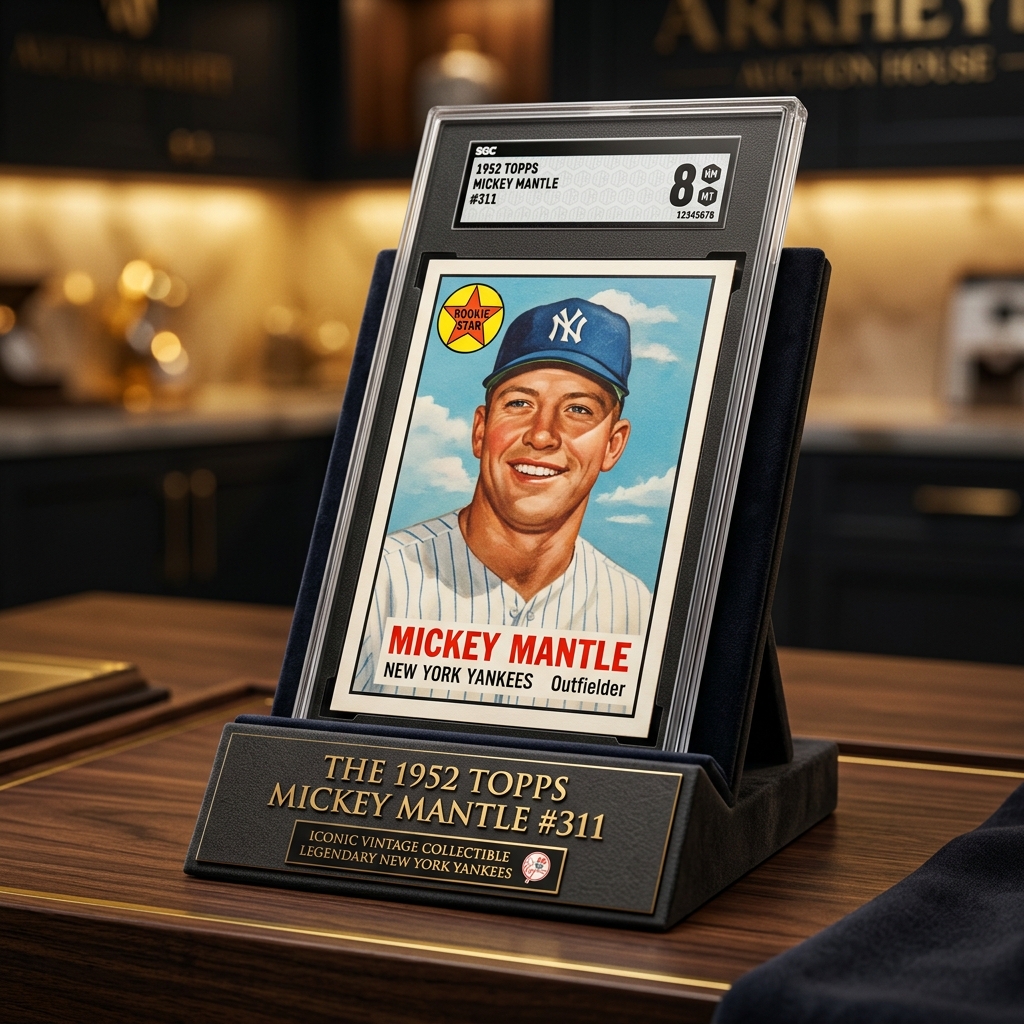
Baseball · 1952
Mickey Mantle #311
Topps Baseball
Raw NM:$5K–$50K+
PSA 9:$2M–$5.2M
From the legendary T206 Honus Wagner to Mike Trout Superfractors, discover which baseball cards command the highest prices — and how to find hidden value in your collection.
The most searched baseball cards of 2026 — with current raw and PSA 10 values. Click any card to get a free estimate on yours.



Baseball cards are the foundation of the American sports card hobby, with a history stretching back to the late 1800s. Today, the top vintage cards regularly trade for millions at auction — while modern rookie cards and rare parallels give collectors and investors fresh opportunities every season. This guide ranks the most valuable baseball cards ever made, explains what drives their value, and shows you how to identify potential gems in your own collection.
Prices reflect recent verified auction results. Raw prices indicate ungraded card values based on condition.
The most iconic baseball card ever made. Wagner reportedly demanded the American Tobacco Company stop producing his card — possibly because he didn't want to be associated with tobacco advertising, or possibly to seek compensation — leaving fewer than 60 known copies in existence. Honus Wagner himself was arguably the greatest shortstop of all time and a first-ballot Hall of Famer, adding legend to scarcity. A PSA 3 sold for $3.75M in 2021; a PSA 8 (the finest known) sold for $7.25M. Even heavily worn examples trade for six figures.
The current record holder for the highest price ever paid for a baseball card at public auction: $12.6 million in August 2022, sold by Goldin Auctions. While technically not Mantle's rookie card (his Bowman rookies came earlier), the 1952 Topps is culturally treated as the definitive Mantle card. It was part of Topps' first major flagship set and features Mantle in his classic Yankees uniform. The '52 Topps set was produced in such large quantities that high-grade copies were once common — but decades of handling have made PSA 9s extraordinarily rare.
The most recognized rookie card of Babe Ruth — widely considered the greatest baseball player in history. The M101-5 Sporting News issue was distributed as a premium with newspaper subscriptions in 1916, making it one of the earliest mainstream baseball card sets. Ruth's card shows him as a 21-year-old pitcher for the Boston Red Sox — three years before his trade to the Yankees. The combination of Ruth's unrivaled legacy, the card's extreme age, and its status as his recognized rookie make high-grade copies multi-million dollar assets.
The rarest Babe Ruth card and arguably the rarest baseball card of any Hall of Famer — fewer than ten examples are known to exist. This card was produced as a local newspaper promotional item in Baltimore, where Ruth played minor league baseball for the Orioles at age 19. A PSA 2 example sold at Heritage Auctions for $6 million in 2021. The card's extreme scarcity, Ruth's towering historical status, and its status as the earliest known Ruth card combine to make it one of the most coveted baseball cards in the hobby.
The crown jewel of modern baseball card collecting: the one-of-one Mike Trout 2009 Bowman Chrome Draft Superfractor autograph. Sold at PWCC for $3.93 million in 2020, this card established a new benchmark for modern era card values. Bowman Chrome Superfractors — the gold-bordered variant numbered 1/1 — are the most prestigious modern card format, and Trout's status as arguably the greatest active player in baseball history makes this particular example priceless to many collectors. Its sale rewrote what collectors believed modern cards could be worth.
Pete Rose holds MLB's all-time hit record (4,256) and remains one of the most controversial figures in baseball. His 1963 Topps rookie card — a multi-player rookie card shared with Al Weis and Ken McMullen — has climbed steadily in value despite Rose's lifetime ban from baseball keeping him out of the Hall of Fame. A PSA 10 sold for $717,000 in 2023. The ongoing debate about Rose's Hall of Fame eligibility, combined with his undeniable on-field legacy, creates unique collector dynamics around his cards.
Mike Trout's most recognized rookie card — the 2011 Topps Update base card was actually a short-printed update to the mid-year update set, making high-grade copies genuinely scarce. A PSA 10 sold for $400,000 at Heritage Auctions in 2021. Trout's repeated MVP awards, his status as the highest-paid player in MLB history (at $426.5M over 12 years), and widespread acknowledgment as the best all-around player of his generation have driven his rookie cards to spectacular heights. Raw copies are still accessible at $500–$2,000.
Roberto Clemente is one of baseball's most beloved figures — a Hall of Fame right fielder with 3,000 career hits who tragically died in a 1972 plane crash while delivering humanitarian aid to Nicaragua. His 1955 Topps rookie card has consistently appreciated, with a PSA 10 fetching $468,000 at Heritage Auctions in 2022. Clemente's crossover appeal — both as a baseball legend and as a cultural and humanitarian icon — gives his cards a broader collector base than most, including significant interest from Puerto Rican and Latin American collectors.
A defining example of condition scarcity: the 1986 Donruss Canseco was printed in massive quantities — making raw copies nearly worthless — but the dark borders on the card design are brutally unforgiving of any edge wear or factory flaws. PSA 10 examples are genuinely rare despite millions of copies existing, and a PSA 10 commands $25,000+. Canseco's 1988 MVP season, his role as the original "40-40" player, and the cultural fascination with the steroid era keep collector interest alive. The grade premium here is as dramatic as any card in the hobby.
Shohei Ohtani is the most unique player in baseball history — a legitimate two-way superstar who dominates as both an elite pitcher and power hitter. His 2021 AL MVP season and 2023 World Baseball Classic heroics have made him a global icon, and his $700 million contract with the LA Dodgers makes him the highest-paid player in professional sports history. His 2018 Topps Update rookie remains the most accessible on this list raw, but PSA 10 copies have climbed to $20,000+ and will likely rise further as his career cements its legendary status.
Beyond established legends, these active player rookie cards offer significant upside as their careers develop. Target PSA 10 copies while prices remain accessible.
One of the best hitters in baseball at just 25. His elite OBP and power numbers have him on a historic trajectory. His 10-year/$765M contract with the Mets makes him one of baseball's most marketable stars.
The Baltimore Orioles shortstop won the AL Rookie of the Year in 2023 and is widely considered one of the best young players in the game. His rookie cards remain relatively affordable for a potential MVP candidate.
The Seattle Mariners outfielder brings a rare combination of elite speed, power, and athleticism. His 10-year extension with Seattle signals the team's belief in his superstar potential.
Milwaukee's outfield sensation signed an 8-year/$82M extension before playing a single MLB game — a rare sign of organizational confidence. His 2024 debut lived up to the hype.
The Pittsburgh Pirates ace arrived in 2024 with historic strikeout numbers and immediately established himself as the future of the Pittsburgh rotation. His Topps rookie cards are must-watch targets.
The #1 overall draft pick and son of former All-Star Matt Holliday. Still developing, but his pedigree and draft status make his rookie cards long-term hold candidates for patient collectors.
Millions of Americans have baseball cards tucked away from childhood. Here's a systematic approach to identifying what's actually worth money:
Everything you need to know about valuable baseball cards, pricing, and selling.
The 1952 Topps Mickey Mantle #311 holds the current record for the most expensive baseball card sold at public auction, fetching $12.6 million in August 2022 at Goldin Auctions. The T206 Honus Wagner, however, remains the most iconic card in the hobby and has sold for over $7.25 million. The Wagner's extreme scarcity (fewer than 60 known copies) and its status as the original "holy grail" card give it an unmatched historical significance, even if the Mantle currently holds the auction record.
Old baseball cards can be extremely valuable — or essentially worthless — depending on three key factors: the player featured (Hall of Famers and legends command premiums), the card's condition (near-mint and graded copies are worth dramatically more), and rarity (first editions, short prints, and error cards add value). A common player from the 1970s in worn condition might be worth pennies, while a Mickey Mantle rookie from 1951 in near-mint condition could be worth tens of thousands. Use CardValueFinder to get a free instant estimate for any card in your collection.
The most valuable 1980s baseball cards are primarily rookie cards from the era's biggest stars. Top targets include: 1986 Donruss José Canseco #39 (PSA 10: $25K+), 1987 Donruss Barry Bonds #361 (PSA 10: $8K+), 1984 Donruss Don Mattingly Rookie (PSA 10: $5K+), 1983 Topps Tony Gwynn Rookie (PSA 10: $4K+), and 1987 Topps Roger Clemens. The key insight: 1980s cards were produced in enormous quantities (the "junk wax era"), so raw copies are often worth just a few dollars — but PSA 10 copies are genuinely scarce due to dark borders and print quality issues, creating dramatic grade premiums.
Four key factors determine baseball card value: (1) Player — Hall of Famers, MVPs, and current superstars command the highest prices. (2) Year and set — rookie cards are almost always worth more than other years of the same player. (3) Condition — graded PSA 10 or PSA 9 copies are worth dramatically more than ungraded copies. (4) Rarity — numbered parallels, autographs, and short prints carry premiums. The fastest way to check: scan your card at CardValueFinder.com for a free instant estimate based on current market data.
Generally yes — rookie cards are the most sought-after cards for any player, especially in near-mint or graded condition. A PSA 10 rookie card is almost always worth significantly more than any other base year card of the same player. However, autograph cards, numbered parallels (especially 1/1 Superfractors), and memorabilia cards can exceed the value of a standard rookie, even when they're not from the rookie year. For the very top players like Trout or Ohtani, signed rookie cards in PSA 10 represent the absolute pinnacle of value.
The best platforms for selling baseball cards: eBay gives you the widest buyer pool and typically the highest prices. PWCC Marketplace runs weekly and premier auctions perfect for high-value graded cards. Goldin Auctions is ideal for ultra-rare vintage cards and PSA 10 gems. MySlabs is a peer-to-peer marketplace focused on graded slabs. Facebook Marketplace and local card shows offer quick cash but often lower prices. For bulk common cards, eBay lot sales or local dealers may be your best option. For a complete walkthrough of how to maximize your sale price, read our guide: How to Sell Sports Cards.