Most Valuable Football Cards: At a Glance
The hobby's most sought-after NFL cards — with current raw and PSA 10 values. Hover to see details.


Top 15 Most Valuable Football Cards in 2026
This comprehensive ranking covers the most valuable football cards across all eras — from pre-war-era vintage grails to modern Prizm rookies — with current market values based on recent auction results and dealer sales. All PSA 10 prices reflect authenticated examples only.
| # | Card | Set & Year | Raw NM Value | PSA 9 Value | PSA 10 Value | Tier |
|---|---|---|---|---|---|---|
| 1 | Johnny Unitas RC | 1957 Topps Football | $1K–$5K | $50K+ | $400K+ | 🏆 Vintage Grail |
| 2 | Jim Brown RC | 1958 Topps Football | $800–$3K | $30K+ | $300K+ | 🏆 Vintage Grail |
| 3 | Joe Namath RC | 1965 Topps Football | $500–$2K | $20K+ | $300K+ | 🏆 Vintage Grail |
| 4 | Walter Payton RC | 1976 Topps Football | $200–$1K | $15K+ | $150K+ | 💎 Blue Chip |
| 5 | Tom Brady RC /1250 | 2000 SP Authentic | $10K–$30K | $40K–$80K | $100K+ | 💎 Blue Chip |
| 6 | Jerry Rice RC | 1986 Topps Football | $100–$400 | $5K–$15K | $50K–$80K | 💎 Blue Chip |
| 7 | Joe Montana RC | 1981 Topps Football | $150–$500 | $8K–$20K | $40K–$70K | 💎 Blue Chip |
| 8 | Dan Marino RC | 1984 Topps Football | $50–$200 | $2K–$5K | $20K–$30K | 💎 Blue Chip |
| 9 | Lawrence Taylor RC | 1981 Topps Football | $40–$150 | $1K–$3K | $10K–$20K | 📈 Investment |
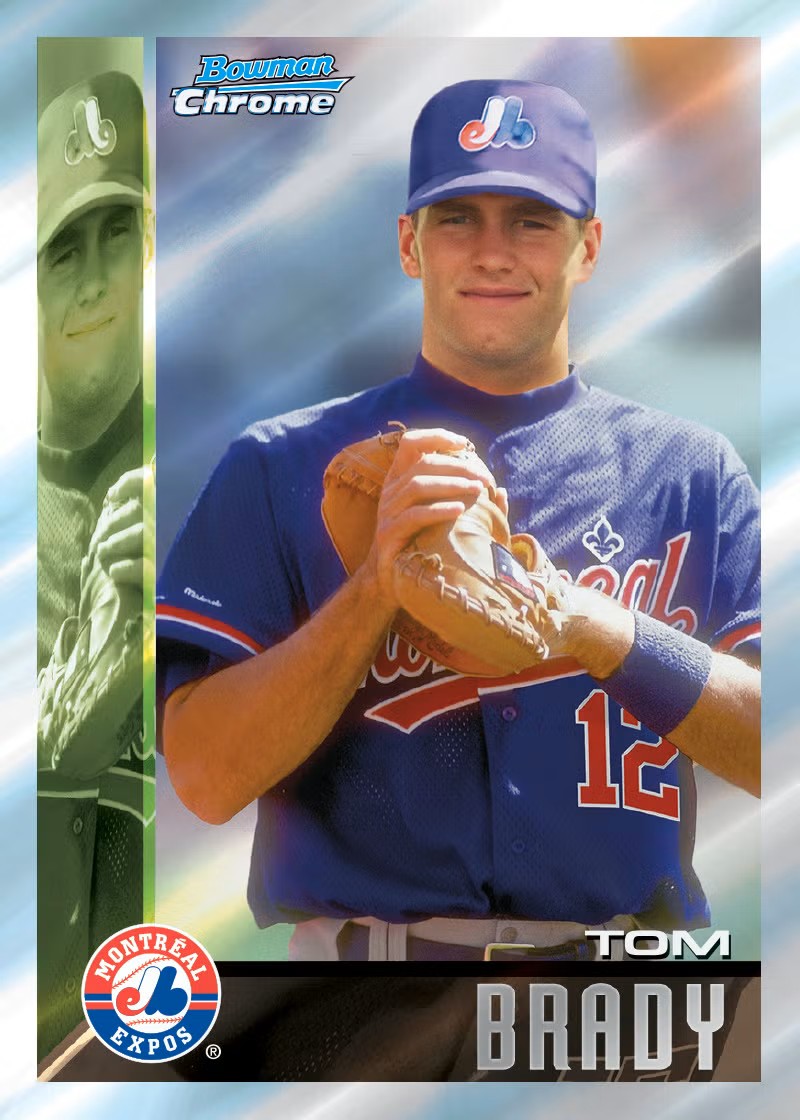
| 10 | Tom Brady RC | 2000 Bowman Chrome | $1K–$3K | $5K–$8K | $12K–$20K | 📈 Investment |
| 11 | Patrick Mahomes RC Silver | 2017 Panini Prizm | $500–$2K | $2K–$4K | $7K–$12K | 📈 Investment |
| 12 | Josh Allen RC Silver | 2018 Panini Prizm | $200–$800 | $1K–$2K | $3K–$6K | 📈 Investment |
| 13 | Lamar Jackson RC Silver | 2018 Panini Prizm | $150–$500 | $800–$1.5K | $2.5K–$5K | 👀 Watch |
| 14 | Joe Burrow RC Silver | 2020 Panini Prizm | $100–$400 | $600–$1.2K | $2K–$4K | 👀 Watch |
| 15 | C.J. Stroud RC Silver | 2023 Panini Prizm | $80–$250 | $400–$800 | $1K–$2.5K | 👀 Watch |
All values reflect recent sold listings on eBay, PWCC, and major auction houses as of June 2026. Raw values assume near-mint (NM) condition unless noted. PSA 10 values require PSA-authenticated Gem Mint examples. Values fluctuate with player performance and hobby market conditions.
Vintage Football Cards (Pre-1990): What Makes Them Valuable
Vintage football cards represent the bedrock of the hobby. Unlike baseball's mass-produced sets from the same era, pre-1980 football cards were printed in far smaller quantities — and far fewer have survived six decades in collectible condition. This fundamental scarcity is what drives the extraordinary prices you see for genuine high-grade examples.
The Golden Era: 1950s and 1960s Topps Sets
The 1957 and 1958 Topps football sets are the crown jewels of vintage football collecting. These were the inaugural mainstream football card sets distributed nationally, and they contain the rookie cards of two of the game's greatest icons: Johnny Unitas (1957) and Jim Brown (1958). The centering on these cards was notoriously inconsistent even when new, and decades of storage in attics, shoeboxes, and rubber-banded piles means the vast majority of surviving copies grade below PSA 5. A genuinely gem-mint example is a statistical outlier — PSA has graded fewer than 5 copies of the Unitas RC at PSA 10 in its entire history, which is why those examples regularly exceed $400,000 when they surface at auction.
The 1965 Topps Joe Namath rookie card occupies a unique cultural position. Broadway Joe transcended football to become a pop-culture phenomenon, and his rookie card benefits from that crossover appeal. Unlike the earlier Topps sets, 1965 Topps used a slightly more modern printing process, but condition sensitivity remains extreme — the card's white borders show the slightest handling wear, making true high-grade copies elusive. At $300,000+ for a PSA 10, it remains one of the most coveted cards in any sport.
Condition Sensitivity and Grading
For vintage football cards, condition is everything. The difference between a PSA 5 and a PSA 8 of the same card can mean a 10× difference in value — and the jump from PSA 8 to PSA 10 can be another 5–10×. The four grading criteria that matter most are: centering (cards must be approximately 60/40 or better on both axes), corner sharpness (even slight rounding drops a grade), surface integrity (no creases, stains, or print defects), and edge quality. For pre-1970 cards, paper stock degradation and vintage printing artifacts can also affect grades.
Authenticity is an increasingly serious concern in the vintage market. As values have climbed, trimming (shaving worn edges to appear sharper), cleaning, and even outright counterfeiting have all emerged. Never purchase a high-value vintage football card without PSA, BGS, or SGC authentication. For cards valued over $10,000, PSA's verification service provides an additional layer of protection. If you own a vintage football card you believe may be valuable, use our free AI scanner to get an initial assessment before investing in grading fees.
Key Vintage Sets to Know
Beyond the headline rookie cards, several complete vintage sets command strong collector interest. The 1952 Bowman Large set predates the Topps era and is historically significant. The 1970–1972 Topps sets contain rookie cards of several Hall of Famers including Terry Bradshaw (1971) and Roger Staubach (1970 Topps Glossy), both of which command substantial premiums in PSA 9 or better. The 1976 Topps set — home to Walter Payton's rookie card — marked a turning point where football cards began to generate serious mainstream hobby attention.
Always check the PSA Population Report before buying or grading a vintage card. If only 2 copies exist at PSA 8 but 200 exist at PSA 6, your raw card is unlikely to grade above that level — and the premium for the PSA 8 reflects true scarcity, not just grade.
Modern Era Football Cards: Prizm, Chrome & the New Standard
The modern football card market is dominated by Panini Prizm and Topps Chrome — two products that use a reflective chromium printing process to create cards with distinctive visual appeal and exceptional condition sensitivity. Understanding how this market works is essential for anyone evaluating a modern football card collection.
Why Prizm Silver is the Benchmark
Panini Prizm football debuted in 2012 and quickly became the definitive modern football card product. The Silver parallel — the base rainbow-foil version with no color designation — is the most liquid modern football card in existence. When collectors, dealers, and investors talk about a modern QB's card value, they almost always mean the Prizm Silver RC. Why? Three reasons: broad recognition (every serious collector knows what it is), consistent grading population (thousands of each player's card have been graded, giving reliable price benchmarks), and liquidity (it's the easiest modern football card to buy or sell at any time).
Patrick Mahomes' 2017 Panini Prizm Silver RC (#269) is the defining example. In PSA 10 condition, it consistently trades for $7,000–$12,000, making it both a serious investment piece and a card frequently sought by fans. The Prizm Silver's chromium surface makes centering, print lines, and surface scratches far more visible than on traditional card stock — which is why only a fraction of raw Mahomes Prizm cards grade at PSA 10. Grading population reports show roughly 10–15% of submitted Mahomes Prizm Silver RCs achieve PSA 10, which is exceptional compared to base Prizm but still means most raw cards will grade lower.
Identifying Key Parallels and Numbered Cards
Prizm and Chrome rookies come in dozens of parallel versions, and not all are equally valuable. The hierarchy generally runs: base Silver → Color Parallels (Gold /10, Black /1) → Prizm Prizms → numbered auto parallels → Rookie Patch Autographs (RPAs). For Mahomes, his National Treasures RPA numbered /99 regularly fetches $20,000–$50,000+, while his Prizm Silver base can be worth thousands but is far more broadly accessible. When evaluating any modern card, always identify the exact parallel: the set name, year, parallel color, and serial number (if any) completely determine value.
Rookie Patch Autographs (RPAs) deserve special mention. These are premium cards — typically from high-end products like National Treasures or Flawless — that contain an authenticated on-card autograph and a swatch of jersey or patch material embedded in the card. For elite QBs, RPAs are often the most valuable version of any modern rookie card. However, they're also the most susceptible to fakes: always verify the autograph against signed examples and purchase only from reputable dealers or with major auction house certification for high-value RPAs.
The On-Field Performance Factor
Modern football card values move with player performance in real-time. Mahomes' cards spiked dramatically with each Super Bowl appearance. Josh Allen's Prizm Silver RC climbed from under $100 in 2018 to $3,000–$6,000 PSA 10 as he became the NFL's most exciting player. C.J. Stroud's cards surged following his rookie-year MVP-caliber performance in Houston. This volatility cuts both ways: players who underperform relative to expectations see their cards crater just as fast. The key principle for modern card investment is simple — buy elite quarterbacks with proven winning records, not potential, and focus on PSA 10 examples rather than raw cards to ensure maximum liquidity when selling.
Beware of "rookie card" confusion in modern sets. Panini produces dozens of products each year, and many contain "rookie" cards that aren't recognized by PSA as a player's "true" rookie card (RC logo). Always check for the official RC designation — it's the only version the hobby universally recognizes as the key rookie.
Not Sure What Your Football Card Is Worth?
Upload a photo to CardValueFinder's free AI scanner. It identifies the exact card, checks current market data, and gives you an instant value estimate — no signup required.
📸 Scan My Football Card Free →