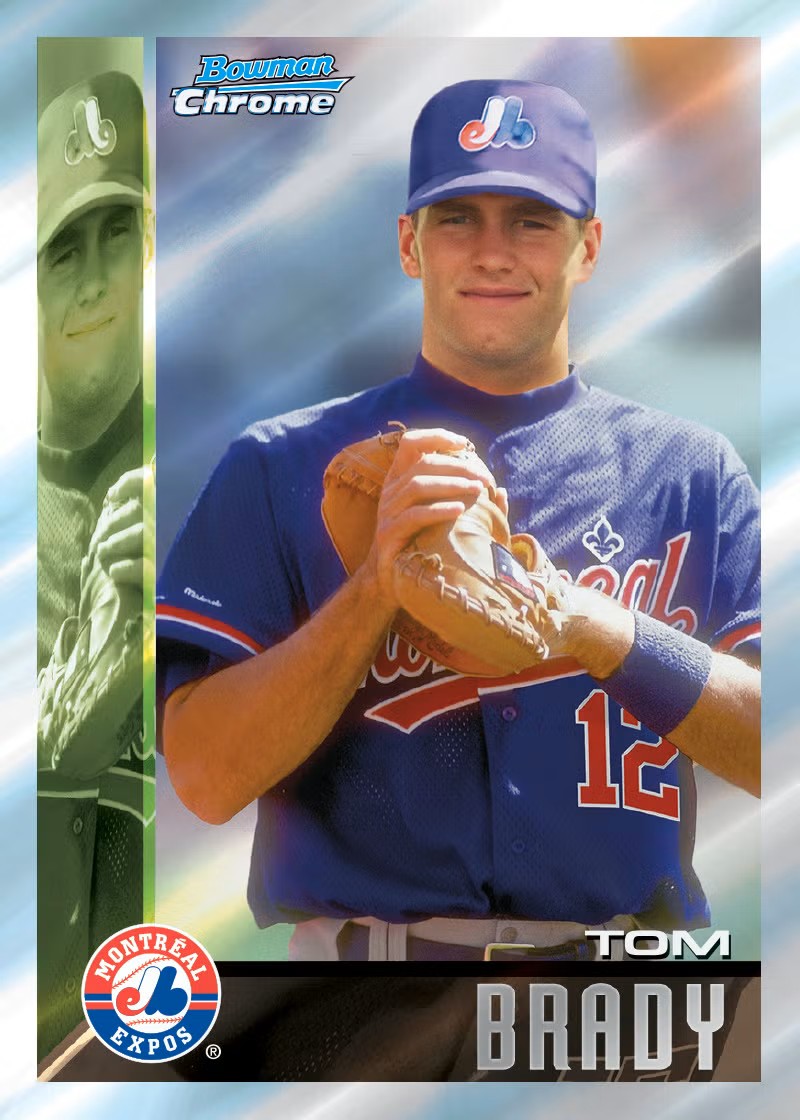
Use our free AI scanner for an instant estimate, or follow this 3-step method to find out exactly what your NFL card is worth — from Brady to Mahomes to vintage Namath.
Instant Results
All NFL Cards
Free Forever
Real Market Data
What's your football card worth right now?
Upload a photo — get an instant AI estimate in seconds. Free.
Our AI recognizes thousands of NFL cards instantly — from vintage Unitas to modern Mahomes Prizm Silver RCs. Upload any card and get a real market estimate in seconds.
2000
Tom Brady
SP Authentic RC
Football · 2000
Tom Brady RC
Bowman Chrome / SP Authentic
Most valuable modern football card. SP Authentic /1250 PSA 10 = $100K+.
The Real Answer to "How Much Is My Football Card Worth?"
Every week, thousands of people discover old shoeboxes of football cards in attics, garages, and storage units — and immediately wonder if they're sitting on a small fortune. The honest answer is: it depends on four things: who's on the card, which specific set and parallel it is, what condition it's in, and what the current market is doing.
A 2017 Patrick Mahomes card can be worth anywhere from $3 to $12,000 depending entirely on whether it's a base card or a Prizm Silver. A 1984 Dan Marino can range from $15 to $12,000 based purely on grade. This guide walks you through the exact process professional card dealers use to value any football card — and our free AI scanner can do it in seconds if you'd rather skip the research.
Whether you're holding a vintage Joe Namath from the 1960s, a 2000 Tom Brady SP Authentic rookie, or a 2023 C.J. Stroud Prizm RC, the framework below will give you an accurate, defensible value you can use when buying, selling, or insuring your collection.
The 3-Step Method to Value Any Football Card
Professional card dealers use this exact process every time they evaluate a card. Follow these steps in order — skipping ahead leads to bad valuations and costly mistakes.
1
Identify Your Card Exactly
Before you can find a value, you need to know precisely which card you have. This sounds obvious, but it's where most people go wrong. The difference between a Mahomes base card ($5) and a Mahomes Prizm Silver ($500+) is invisible to the untrained eye — they look nearly identical front-on.
Key identifiers to document:
Year and manufacturer — printed on the card back (e.g., "2017 Panini Prizm")
Card number — the #XXX on the card back; critical for identifying the exact set
Parallel type — does the card have a chrome/foil finish? Is there a colored border (green, orange, gold)?
Serial number — printed as "/199" or "/10" on the card surface means it's a numbered parallel, worth significantly more
Autograph — on-card ink auto vs. sticker auto vs. no auto
Patch/Memorabilia — does the card contain a jersey swatch or patch window?
Chrome vs. base distinction: Chrome cards have a reflective, mirror-like surface. Base cards have a flat, matte or semi-gloss look. Chrome parallels (Refractor, Prizm Silver, Prizm Gold) are almost always the most valuable versions in any given set — some worth 50–200x the base card price.
If you can't identify the card by looking at it, CardValueFinder's AI scanner will identify the exact card — including parallel type — from a single photo. It cross-references against a database of millions of cards to give you a precise match in seconds.
2
Assess Your Card's Condition Honestly
Condition is the single biggest driver of value after player identity. A PSA 10 Gem Mint copy of a card can be worth 5–20x more than the same card in PSA 7 Near Mint. Learning to evaluate condition honestly — and brutally — is essential to not overestimating what you have.
Grade
Description
Value Multiplier vs. Raw
PSA 10 Gem Mint
Perfect corners, centering, surface. No flaws visible under 5x magnification
3–10x raw value
PSA 9 Mint
1–2 minor flaws (slight surface scratch, minor centering off). Still excellent
1.5–3x raw value
PSA 8 NM-MT
Slight wear on corners or edges. One or two minor defects
0.8–1.2x raw value
PSA 7 NM
Light corner wear, minor surface marks. Still presentable
0.4–0.7x raw value
PSA 6 EX-MT
Visible corner wear, some surface issues, minor creasing possible
Self-assessment checklist — examine your card under good lighting:
Hold the card at an angle under a lamp — surface scratches will catch the light
Check all four corners under a magnifying glass — corner fraying is the #1 value killer
Look at centering — the white border should be roughly equal on all sides (allow 55/45 for a PSA 9)
Check the edges for nicks, chips, or dents — run your fingernail gently along each edge
Inspect the back — stains, writing, or rubber band marks severely impact grade
Be honest about print defects — any factory lines or spots count against grade
Common mistake: Most people overgrade their cards by 1–2 points. When you think you have a PSA 9, it's usually an 8. When you think it's an 8, PSA usually returns a 7. Grade conservatively when estimating value.
3
Check Current Market Prices
You now know exactly what card you have and a realistic condition estimate. The final step is finding what that specific card is actually selling for right now — not what someone is asking, but what buyers are actually paying.
Method A: eBay Sold Listings (Free, DIY)
Go to eBay and search for your exact card: "2017 Panini Prizm Patrick Mahomes #269 Silver"
On the left sidebar, under "Show only," check "Sold Items"
Set date filter to last 30 days — older sales are less reliable in a moving market
Filter by condition (graded vs. raw) to match your card
Ignore outlier sales (both high and low) — use the median of 3–5 recent comps
Method B: CardValueFinder AI Scanner (Free, Instant)
Upload a photo of your card — front and back — and our AI identifies the exact card, parallel, and condition estimate, then returns a current market value range based on real recent sales. Takes about 15 seconds. No account required.
Method C: PSA SMR Price Guide
For graded cards specifically, PSA publishes the SMR (Sports Market Report) guide with grade-by-grade values. Best for vintage cards where sales are infrequent and you need a reference price rather than a real-time comp.
Football Card Value by Era
The era a card was produced in dramatically affects its collectibility, supply, and value. Here's a breakdown of the major football card collecting eras and what you can expect from key cards in each period.
Era
Years
Key Cards
Typical Value Range
Vintage
1950s–1970s
Johnny Unitas RC, Joe Namath RC, Walter Payton RC, Jim Brown RC
$500–$400K+
1980s Stars
1980–1989
Joe Montana RC, Jerry Rice RC, Dan Marino RC, Lawrence Taylor RC
Tom Brady RCs, Peyton Manning auto, Andrew Luck RC, Russell Wilson RC
$50–$100K+
Prizm Era
2017–Present
Patrick Mahomes RC, Josh Allen RC, Joe Burrow RC, C.J. Stroud RC
$50–$12K+
* Value ranges represent key rookie cards in near-mint condition. Common players within each era are worth significantly less. PSA 10 graded copies command premiums above listed ranges.
What Makes a Football Card Valuable? 6 Key Factors
Every football card's value is determined by a combination of these six factors. The more boxes a card checks — and the more extreme each factor — the higher the value ceiling.
🏆
Player Status (HOF vs. Common)
Tom Brady, Jerry Rice, and Walter Payton cards carry permanent premium demand because of Hall of Fame status. Current stars like Mahomes and Allen command high prices on performance. A common backup QB's rookie card is worth $1 regardless of the set.
📅
Year (Rookie Year Is Everything)
A player's official rookie year card is almost always their most valuable. The 2017 Mahomes RC is worth $500–$12,000. A 2018 Mahomes card of equal design might be worth $20–$100. Collectors pay a permanent premium for the "first year" card of any significant player.
🃏
Set & Brand (Prizm vs. Base Topps)
Panini Prizm Silver is the gold standard of modern football cards — instantly recognizable chrome finish, limited production, universal demand. A base Topps card of the same player in the same year might be worth 1% of the Prizm value. Brand and set matter enormously.
⭐
Condition & Grade (PSA 10 vs. Raw)
A PSA 10 Gem Mint copy of a key card can be worth 5–10x a PSA 7. For modern chrome cards where PSA 10s are scarce (sub-5% population), the premium can be even higher. Condition is the great equalizer — a perfect common can be worth more than a worn superstar card.
🔢
Print Run (Numbered vs. Unlimited)
Numbered parallels like Gold /10, Orange /199, and Green /149 command significant premiums over unlimited-print base and Silver cards. The lower the print run, the higher the scarcity premium. A 1/1 "Super" parallel of almost any key player is worth thousands regardless of condition.
✍️
Autograph & Patch (RPA = Maximum Value)
Rookie Patch Autographs (RPAs) are the holy grail of modern card collecting. A Mahomes 2017 National Treasures RPA /99 in PSA 10 has sold for $100,000+. On-card autos with multi-color patches from game-worn jerseys are the combination collectors pay the most for.
When Should You Grade Your Football Card?
Grading through PSA, BGS, or SGC can dramatically increase a card's value — but it's not always worth it. Grading costs $25–$150+ per card (plus shipping and insurance) and can take weeks to months. Here's the framework for deciding whether to grade.
✅ DO Grade If…
It's a Mahomes, Allen, Burrow, or Brady RC that appears NM+ (no visible flaws)
It's any vintage HOF player RC (Namath, Montana, Rice, Brown) in EX or better condition
It's a numbered parallel (/199 or lower) of a current star or HOFer worth $100+ raw
The card has an on-card autograph and appears unaffected by pen bleed or smearing
You plan to sell and want maximum buyer confidence — graded cards sell faster and for more
It's a Pre-War or 1950s era card in any playable condition — scarcity makes grading worthwhile
❌ DON'T Grade If…
The card shows obvious heavy wear, creases, writing, or corner rounding visible to the naked eye
It's a common player (backup QB, offensive lineman) from any era — grading won't increase value enough to cover fees
The raw value is under $20 — grading fees will cost more than the card is worth
It's a 1990s overproduction-era base card — billions were printed, grades don't command premiums
You're in a hurry to sell — current PSA turnaround for economy tier is 45–90+ days
Real answers to the most common football card valuation questions — no fluff, no filler.
The fastest free method is CardValueFinder's AI scanner — upload a photo and get an instant estimate in seconds. Alternatively, search eBay sold listings filtered to the last 30 days for your exact card (make sure to filter "Sold Items" not active listings). The combination of AI identification plus real recent sales gives you the most accurate current market value. For vintage cards, the PSA SMR Price Guide provides grade-by-grade reference prices at no cost.
Tom Brady has two key rookie cards from 2000: the Bowman Chrome and the SP Authentic. The SP Authentic RC #/1250 in PSA 10 has sold for over $100,000 — making it one of the most valuable modern sports cards ever. The Bowman Chrome PSA 10 ranges from $12,000–$20,000. Even raw (ungraded) NM copies command $2,000–$5,000. Brady base cards from other 2000 sets (Topps, Fleer) are far less valuable, typically $50–$500 depending on condition. Use our scanner to identify which Brady RC you have before assuming a value.
Patrick Mahomes' 2017 Panini Prizm Silver RC (#269) is the most sought-after modern football card. PSA 10 copies sell for $7,000–$12,000. Raw NM copies typically fetch $500–$2,000 depending on centering and surface quality. There are hundreds of Mahomes rookie parallels — Prizm Gold /10, Orange /199, Green /149 — each commanding a significant premium over the base Silver. A base Panini Prizm (non-silver, non-chrome) RC trades around $100–$300 raw. His 2017 National Treasures RPA (Rookie Patch Auto) /99 has sold for $100,000+.
The most valuable 1980s football cards include: Joe Montana 1981 Topps RC ($500–$80,000 PSA 10), Jerry Rice 1986 Topps RC ($300–$15,000 PSA 10), Dan Marino 1984 Topps RC ($200–$12,000 PSA 10), Lawrence Taylor 1981 Topps RC ($150–$8,000 PSA 10), and Walter Payton 1977 Topps ($500–$20,000 PSA 10). Condition is absolutely critical for 1980s cards — high-grade copies are extremely scarce and command massive premiums over mid-grade examples. A Montana PSA 7 might sell for $500; the same card in PSA 10 can exceed $80,000.
For cards from 2006 onward, look for the official RC (Rookie Card) logo on the card face — a shield with "RC" that was standardized by the major card manufacturers to eliminate confusion about which year counts as the true rookie. For older cards, the first-year card is generally accepted as the rookie card even without an official logo. Match the card year to the player's first NFL season: Brady = 2000, Manning = 1998, Mahomes = 2017, Burrow = 2020, Stroud = 2023. Our AI scanner automatically identifies rookie card status from a photo.
A base card is a standard, unlimited-print card — typically worth $1–$20 for most modern players. A Prizm Silver card features a distinctive chrome-like holographic finish, limited production, and is produced by Panini specifically for the Prizm set — one of the most prestigious brands in modern collecting. Prizm Silver cards are 10–100x more valuable than base cards of the same player. Prizm also has numbered parallels: Gold /10, Orange /199, Green /149, Blue /199 — each commanding further premiums. Always check the card surface (shiny and reflective = chrome/prizm) and the card back for a serial number.
Grade your card if: it's a key rookie card (Brady, Mahomes, Allen, Burrow) that appears near-mint or better with no visible flaws; a vintage HOF RC in EX condition or better; or any numbered parallel (/199 or lower) of a current star worth $100+ raw. Skip grading if the card shows obvious wear, is a common player, or has a raw value under $20 — grading fees typically run $25–$150+ per card and take weeks to months, making it economically pointless for low-value cards. See our full Sports Card Grading Cost Guide for current PSA and BGS pricing.
eBay remains the largest marketplace with the most active buyers — best for cards worth $50 and up. PWCC Marketplace and Goldin Auctions specialize in high-value cards ($1,000+) and attract serious collectors willing to pay market price. Facebook Marketplace and local card shops (LCS) work well for bulk commons and lower-value lots. COMC (Check Out My Collectibles) lets you consign cards without managing individual sales. For graded cards specifically, MySlabs and StarStock offer efficient P2P trading. Always check recent eBay sold comps before listing anywhere — pricing your card correctly is the single biggest factor in making a fast, fair sale.
Related Guides
Explore more football card value resources from CardValueFinder.